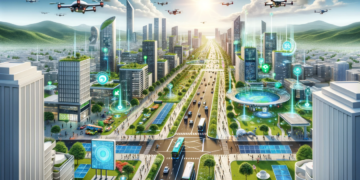
The urban landscape is on the cusp of a revolutionary transformation. By 2025, the concept of a “smart city” will evolve from a futuristic ideal into a tangible, interconnected reality, fundamentally reshaping how we live, work, and interact with our environment. This evolution is driven by a convergence of cutting-edge technologies like AI, IoT, and renewable energy, all working in symphony to tackle pressing urban challenges such as congestion, pollution, and resource management. For municipal leaders, tech innovators, and citizens alike, understanding these breakthroughs is crucial to navigating and thriving in the cities of tomorrow. This comprehensive guide delves into the most significant smart city innovations poised to redefine urban life in 2025 and beyond.
A. The AI-Powered Digital Twin: Urban Management Revolutionized
At the heart of the next generation of smart cities lies the concept of the “Digital Twin.” This is far more than a simple 3D model or a GIS map. A digital twin is a dynamic, virtual replica of an entire city its buildings, infrastructure, traffic networks, energy grids, and even people flows that is continuously updated in real-time via a vast network of IoT sensors.
This living model allows city planners and AI systems to run simulations, predict outcomes, and optimize operations without any real-world risk. For instance, before implementing a new traffic flow pattern, officials can test it in the digital twin to see its impact on congestion, emergency response times, and local air quality. It enables predictive maintenance; the AI can analyze data from sensors on a bridge to forecast structural failures long before they happen, scheduling repairs proactively and saving enormous costs. In 2025, we will see mid-sized cities begin to adopt this technology, moving it from a luxury for global megacities to a standard tool for efficient urban management.
B. Autonomous Public Transit Networks: The Self-Driving Bus
While self-driving cars have dominated headlines, the most impactful autonomous vehicle (AV) innovation for smart cities will be in public transit. Expect to see the widespread deployment of autonomous electric buses along fixed routes in 2025. These vehicles use a combination of LiDAR, radar, and advanced computer vision to navigate pre-mapped urban corridors safely.
The benefits are multifold. They operate 24/7, providing constant service without driver fatigue, drastically improving late-night mobility. They can communicate with traffic signals (V2I – Vehicle-to-Infrastructure) to always catch a “green wave,” improving efficiency and reducing journey times. Furthermore, their predictable, software-defined routes make them incredibly safe and efficient, encouraging a greater shift from private car ownership to shared public mobility, which is essential for reducing urban congestion.
C. Self-Healing Water Infrastructure: Stopping Leaks Before They Start
Water scarcity and the massive waste from leaky, aging pipes are critical urban issues. Smart water grids equipped with self-healing technology are a game-changing solution. These systems use a network of acoustic sensors and pressure monitors spaced throughout the water pipeline network. These sensors constantly listen for the specific sound signatures of leaks or even pre-leak stress points.
When a potential leak is identified, the system can automatically isolate that section of the pipe by triggering smart valves. In more advanced setups, pipes are being developed with micro-encapsulated healing agents that are released upon the formation of a crack, automatically “plugging” the damage without human intervention. This technology not only conserves a precious resource but also saves cities millions in wasted water, emergency repair costs, and prevented property damage.
D. Hyperlocal Air Quality Monitoring Microstations

Traditional air quality monitoring relies on a few, large, expensive stations per city, providing a general but imprecise picture. 2025 will see the explosion of hyperlocal air quality monitoring. Networks of hundreds of small, solar-powered, wireless sensors will be deployed on lamp posts, buildings, and bus stops, creating a real-time, block-by-block map of pollutants like PM2.5, NO2, and ozone.
Citizens can access this data via apps to choose the healthiest route for a walk or run. City health officials can identify pollution hotspots with pinpoint accuracy, correlating them with traffic patterns or industrial activity and implementing targeted solutions. This data is also invaluable for clinical studies on public health, enabling researchers to understand the direct effects of air quality on respiratory and cardiovascular diseases in specific communities.
E. Biophilic Design and Vertical Urban Farming
Smart cities of 2025 will be greener, literally. Biophilic design the integration of nature into architectural and urban planning—will move from a trend to a standard. This goes beyond parks and includes green walls, rooftop gardens, and integrated waterways. The key smart innovation lies in how these natural elements are managed.
Sensor-equipped green walls can optimize irrigation based on real-time weather data and soil moisture levels. Furthermore, vertical farming within city limits will become a major innovation. These AI-controlled, hydroponic farms housed in repurposed buildings use 95% less water than traditional agriculture and grow food miles, not thousands of miles, from consumers. They provide fresh, local produce, reduce the carbon footprint of food transportation, enhance food security, and even help moderate urban heat island effects.
F. Unified Urban Security Platforms
Public safety is being transformed through integration. Instead of disparate systems for police, fire, and emergency medical services, smart cities are adopting unified urban security platforms. These platforms aggregate data from thousands of sources: gunshot detection microphones, CCTV with real-time video analytics, social media feeds, and emergency call reports.
An AI engine processes this data to provide a Common Operating Picture (COP) for dispatchers and first responders. For example, if a fire is reported, the system can automatically analyze traffic camera feeds to plot the fastest route for fire trucks, identify the building’s blueprint for firefighters, and send automated alerts to residents in the immediate vicinity with evacuation instructions, all within seconds. This holistic approach significantly improves response times and situational awareness, saving lives.
G. 5G-Enabled Smart Lampposts: The Unsung Heroes
The humble lamppost is being reinvented as the Swiss Army Knife of smart city infrastructure. These are no longer just for light. Next-generation smart lampposts are multi-functional hubs integrating:
-
LED Lighting: With adaptive dimming that brightens only when motion sensors detect pedestrians or vehicles, saving energy.
-
5G Small Cells: Providing the high-speed, low-latency connectivity backbone for the entire IoT ecosystem.
-
Public Wi-Fi: Offering free internet access to citizens.
-
Environmental Sensors: Monitoring air quality, temperature, and humidity.
-
Security Cameras: Enhancing public safety.
-
Electric Vehicle (EV) Charging Points: Solving the infrastructure challenge for EV adoption.
-
Digital Signage: For public announcements and emergency alerts.
By consolidating these functions into a single, ubiquitous piece of street furniture, cities reduce clutter, lower installation costs, and create a dense network of data collection and communication points.
H. Blockchain for Civic Identity and Transparent Governance
Blockchain technology will find its killer application in smart cities through civic identity and governance. Imagine a secure, decentralized digital ID for every citizen. This ID could be used to access all municipal services—paying taxes, applying for permits, voting in local elections, using public libraries with a single, secure login, eliminating countless passwords and bureaucratic hurdles.
Furthermore, blockchain’s immutable ledger is perfect for ensuring transparency in government spending. Municipal budgets and contracts can be recorded on a blockchain, allowing any citizen to track how public funds are allocated and spent in real-time, fostering a new era of trust and accountability between residents and their local government.
I. Predictive Analytics for Homelessness and Social Care Intervention

One of the most humane applications of smart city technology is in social services. By applying predictive analytics to anonymized data from various agencies (health, housing, police, welfare), AI models can identify individuals and families at extreme risk of homelessness long before they end up in crisis.
For example, the system might flag a household that has faced a sudden job loss, has mounting utility bill debt, and has a history of mental health challenges. This allows social workers to proactively reach out with targeted support programs rent assistance, job training, counseling preventing the downward spiral into homelessness. This shifts the model from reactive crisis management to proactive, compassionate intervention, making the city smarter in a profoundly human way.
J. Waste Management Reimagined: Smart Bins and Dynamic Collection
Gone are the days of fixed-schedule garbage truck routes that empty half-full bins or miss overflowing ones. Smart waste management uses solar-powered bins equipped with ultrasonic fill-level sensors. These bins compact trash internally to increase capacity and transmit their status to a central management platform.
The system’s AI then calculates the most efficient daily collection routes, directing trucks only to bins that are actually full. This optimization leads to massive reductions in fuel consumption, truck emissions, noise pollution, and labor costs. Some advanced systems even incorporate RFID tags to enable pay-as-you-throw schemes, incentivizing recycling and reducing the overall volume of waste sent to landfills.
Conclusion: The Human-Centric Smart City
The breakthroughs defining smart cities in 2025 share a common thread: they leverage data and connectivity not for technology’s sake, but to solve real human problems. The ultimate goal is not to create a cold, automated metropolis, but to build a more livable, sustainable, efficient, and equitable urban environment. The success of these innovations will not be measured in terabytes of data processed, but in minutes shaved off daily commutes, in reduced asthma rates among children, in lives saved by faster emergency responses, and in communities that are more engaged with their governance. The future smart city is a partnership between technology and its citizens, and that future is arriving now.